
The purpose of this article is simply to call attention to a pervasive problem in the law enforcement profession. Solutions to the problem can be fleshed out in future discussions. But without adequately demonstrating that a problem exists, discussion about making procedural changes is pointless.
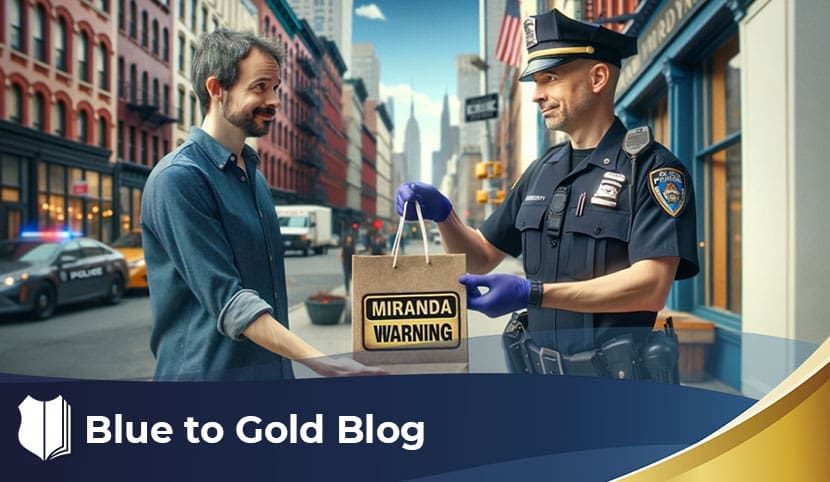
As a profession, law enforcement officers over-Mirandize. Without question. I call this phenomenon “handing out Miranda gift bags”—free, unearned Miranda warnings, given simply for showing up. I think there are two primary reasons why officers hand out Miranda gift bags. First, television. Whenever Elliot and Olivia make an arrest, a Miranda warning invariably soon follows. It’s as if the warning is part and parcel of the arrest; without the warning, the arrest is left unconsummated. Wrong, of course. But the simple fact is, Miranda warnings have long since become part of American culture.
The second reason, and the more important one within the law enforcement profession, is that officers do it as some sort of a “CYA” endeavor. The Fifth Amendment privilege against compelled self-incrimination, from which the Miranda rule derives, carries with it a textual basis for the exclusion of evidence. The Miranda rule is constitutionally required and therefore, a violation of such carries with it the sanction of inadmissibility (generally) in a subsequent criminal case where the victim of the violation is a defendant. In order to “be safe” many officers are taught, even required in some cases by policies and regulations, to hand out a Miranda gift bag “just in case” the person
being questioned says something self-incriminating that may be useful in a subsequent prosecution.
I can think of at least three reasons why giving free Miranda warnings is problematic and should be discouraged (or perhaps even disallowed!). First, it could cause a person
who had otherwise been willing to answer an officer’s questions to now elect to not answer any questions. By being reminded of his free-standing right to remain silent, he
has decided to exercise that right. But perhaps had he not been warned, he would have agreed to answer the officer’s questions, potentially furthering the investigation. The
giving of the Miranda gift bag has inhibited effective investigation in this sense. Second, also along the lines of inhibiting effective investigation, a Miranda gift bag
followed by an invocation of the right to counsel bars any subsequent custodial interrogation efforts by any officer during that same period of custody. For example, a
patrol officer makes an arrest and then gives a Miranda warning, having no intention of asking any potentially incriminating questions. He just does it because that’s what they
do on television (or worse, because his agency policy needlessly requires all arrestees to be informed of their Miranda rights!). The arrestee tells the officer, “I want a lawyer.”
The officer replies, “I don’t care. I wasn’t planning on asking you any questions anyway.” The officer then transports the arrestee to jail. Waiting at the jail is a detective who has
learned of the arrest and wants to question the arrestee about a different matter than that for which the arrest was made. The Edwards rule (part of the Miranda rule) likely
bars the detective from even asking the arrestee if he would be willing to answer the detective’s questions, regardless of whether the detective was aware of the prior
invocation of the right to counsel. Effective investigation once again inhibited by a Miranda gift bag!
And third, part of the warning is simply not true in a Miranda gift bag scenario. The Miranda gift bag scenario presupposes the person to be questioned is not in “custody”
(a requirement under the Miranda rule). The part of the warning about a right to counsel is not true in that case. A person does not have a Fifth Amendment right to have
counsel present during a non-custodial interrogation. And the government certainly is not going to pay for that lawyer, also contrary to the Miranda warning. The officer in this
case is being less than truthful with the person as to what his constitutional rights actually are. I would think that a police officer misleading a person as to his rights would be frowned upon by society.
No more Miranda gift bags. No more free Miranda warnings “just to be safe.” Under the Fifth Amendment, a person must earn a Miranda warning, i.e., do something that
renders him subject to custodial interrogation. No custody, no warning. It really is that simple. (Yes, there is one situation where an out-of-custody should be given a Miranda
warning. And that is where it is given in an attempt to obtain a waiver of the Sixth Amendment right to counsel. But that is an infrequent circumstance.)