

In the complex and dynamic world of law enforcement, the ability to recognize and interpret human behavior under stress is a powerful asset. The human threat response—commonly referred to as freeze, flight, and fight—is a survival mechanism hardwired into our biology. Many times, you will hear the order of those responses be referred to differently, commonly calling it the “fight, flight, or freeze response.”
In this article as well as in my class, “Mastering Proactive Policing for Patrol,” I refer to it in the order of freeze, flight, or fight. This order is by design, as it is the true order that I have seen the response play out as it relates to police work, as well as the order that has been taught to me by my mentors in the human behavioral world who also focus on its role in the law enforcement realm.
While this human threat response evolved to protect individuals from danger many years ago, it can also inadvertently expose those who are engaged in, about to be engaged in, or those who have just engaged in some level of criminal activity, and are also carrying that guilty knowledge of their actions, coupled with their fear of police detection.
Understanding these responses and what they look like as they are unfolding in front of the observer—in this instance, the police officer—can significantly enhance successful proactive policing techniques, enabling officers to detect suspicious behavior more effectively during patrols, stops, and community engagements, as well as being able to articulate them in their reports and while providing court testimony.
1. Freeze: The Initial Instinct
The freeze response is the first stage of the threat response. When someone perceives danger—such as making visual or audible recognition of the sudden presence of law enforcement in proximity to their own position—they may instinctively freeze. This is an unconscious attempt to avoid detection and assess the threat. This is an honest reaction, as the human threat response leaps into action before the person can decide if the perceived threat is credible or not. The freeze response can take shape both physically and verbally, as it is displayed by someone reacting to police presence.
Observable behaviors:
- Sudden stillness or cessation of movement when noticing police.
- Fixated gaze; a change in posture from one that is relaxed and open to one that is of low confidence, with the shoulders up, chin tucked, and head down, consistent with trying to hide in plain sight.
- Holding an unnatural posture, such as tensing up or “locking in place.” The “deer in headlights” look will commonly be observed at this time as well.
- While operating a motor vehicle or other form of transportation, the person rapidly brakes, decreases speed, or stops altogether.
Proactive policing insight: Officers on patrol should be trained to recognize this initial moment of hesitation or unnatural stillness as a potential indicator of stress or guilt. While a freeze response doesn’t confirm criminal behavior, it can be a preliminary cue to dig deeper, giving us the confidence to then attempt to find a lawful violation to conduct a stop of the person operating a vehicle, bicycle, or traveling on foot.
2. Flight: The Urge to Escape by Physically Distancing
If the freeze phase doesn’t de-escalate the perceived threat—or in other words, achieve the desired effect—the next instinctual response is flight. This can manifest as an attempt to physically escape, or more subtly, as behavioral avoidance—such as changing direction when spotting officers, physically creating distance between the officer and oneself, and/**or putting physical buffers or barriers between their position and police. These behaviors show themselves as the person reacting and making physical efforts to avoid being apprehended by police.
Observable behaviors:
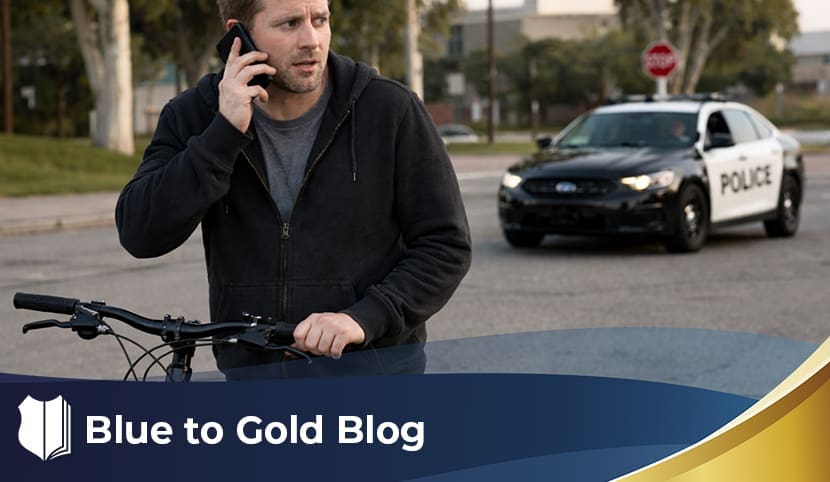
- Sudden or unprovoked movement away from officers or patrol units. Depending on whether the person is on foot, in a vehicle, on a bicycle, or using another mode of transportation, this movement away from the officer, commonly referred to as distancing behavior, can take on a variety of different appearances, but ultimately, the goal is always the same: get as far away, as fast as possible, from the officer, without looking too obvious. Simply put, a good starting point for an officer looking for potential suspects is to watch who begins to distance themselves upon their presence. If in a vehicle, who is taking rapid turns away? Who is switching lanes, even when it is unsafe to do so or there is an unsafe gap to fit into between vehicles at that moment? Who changes direction now that an officer has come into their view? Who pulls into the parking lot you are in, not having previously seen you sitting there, but now that they have, leaves entirely without conducting any legitimate business? These are questions you need to ask yourself as you conduct patrol.
- Pre-flight indicators: adjusting clothing (e.g., waistband checks), tightening backpacks, tying shoelaces, stretching out, nervous glances toward exits, alleyways, or areas of cover.
- Attempting to leave an area quickly after noticing police.
3. Fight: The Defensive Aggression
When escape seems impossible or when the individual feels cornered, the final threat response—fight—kicks in. This response is particularly dangerous and unpredictable. It can range from verbal hostility to full physical assault.
Observable behaviors:
- Clenched fists, jaw tightening, or sudden changes in voice tone.
- Rapid breathing, pacing, or squared shoulders (a pre-attack indicator).
- Reaching toward the waistband or pockets—a common sign of arming or bluffing.
- Refusing commands with increasing agitation.
- Streamlining—the suspect begins shedding items from around their face, head, and/or neck such as a lanyard, necklace, pair of sunglasses, hat, earrings, etc.
- Nasal wing dilation/nostrils flaring—as the body oxygenates, preparing for physical action.
- Verbally attacking the officer, making accusations of racism, harassment, illegal policing, threats of lawsuits, getting them fired, or other tactics.
- Repeatedly attacking the validity and basis for the stop.
Proactive policing insight: Recognizing the precursors to aggression allows officers to either de-escalate or tactically reposition to ensure safety. Training should emphasize reading nonverbal cues, using verbal de-escalation techniques, and understanding the link between fight responses and perceived loss of control.
Final Thoughts
The human threat response system is universal—but how individuals manifest freeze, flight, and fight can vary based on context, past experiences, and intent. For law enforcement officers, the value lies in recognizing the patterns of behavior that suggest someone may be reacting not just to fear—but to the presence of authority due to guilt or criminal intent. These physical reactions, as they unfold in real-time, are honest reactions. These responses give an officer a focus point to then continue observing and determine, as they get closer to the person and begin following from a distance, whether more behaviors show themselves. These behaviors will show themselves at all levels of criminal activity, from someone driving while suspended or with a minor traffic warrant, all the way to someone who has just committed an armed robbery or homicide. It is the job of the police officer to observe the reaction, find a lawful basis for the stop such as a traffic offense or city ordinance violation to conduct a stop, and then once stopped, investigate to determine what level they are dealing with.
By sharpening awareness of these instinctual behaviors and incorporating them into proactive policing techniques, officers can enhance both officer safety and public safety, while improving the effectiveness of patrol-based crime detection.