
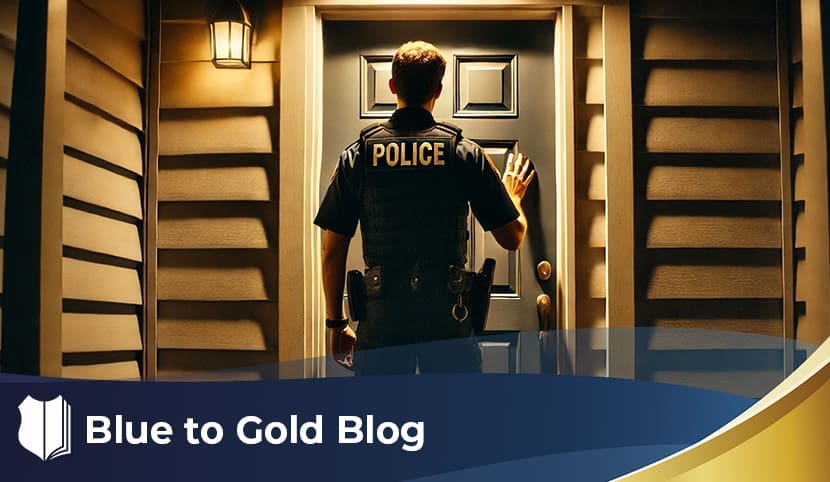

Officers go to a person’s residence during an investigation. They do not have an arrest warrant. The concern raised is officers going to someone’s home or porch with the intent to arrest them and using a knock on the door as a way to accomplish that arrest. There is no suggestion that the occupant has invited officers inside, and there is no indication of exigent circumstances. Instead, officers may be seeking to make contact, gather information, or hear the person’s side of the story.
This scenario involves a knock-and-talk at a private residence, including areas immediately connected to the home such as the porch. Officers approach the residence, knock on the door, and wait a reasonable amount of time for a response. If the person answers, officers may want to speak with them. If no one answers, officers leave. The legal question is whether officers may go to a home or porch with the purpose of making a warrantless arrest, and how Payton v. New York applies to that situation.
Alright, now let’s talk about what the law is. The home and its curtilage receive the highest level of Fourth Amendment protection. In Payton v. New York, 445 U.S. 573 (U.S. Supreme Court 1980), the Court held that police may not make a warrantless and nonconsensual entry into a suspect’s home to make a routine felony arrest. The Court drew a clear constitutional boundary, stating, “the Fourth Amendment has drawn a firm line at the entrance to the house.”
Courts recognize a limited implied license that allows officers, like any member of the public, to approach a residence, knock on the door, wait briefly, and attempt to speak with the occupant. That implied license exists for consensual contact only. It does not include authority to enter the home, remain on the curtilage for extended periods, or take actions that convert the encounter into a coercive or nonconsensual arrest.
Intent and conduct matter. Courts do not want officers using the knock-and-talk doctrine as a workaround to avoid the warrant requirement imposed by Payton. There is no implied invitation for officers to come onto the porch or curtilage for the sole purpose of arresting someone. The implied license ends if officers exceed the scope of what an ordinary visitor would do or if the objective is arrest rather than conversation.
Alright, with these facts and laws in mind, here is the answer. Payton v. New York applies when officers attempt to arrest a person at their home or its protected areas without a warrant. Officers may not go to a residence or porch with the intent to arrest someone and rely on a knock-and-talk to justify that arrest. There is no implied consent for that purpose.
Officers may lawfully approach the home to attempt consensual contact if the goal is legitimate information gathering or hearing the person’s side of the story. They may knock, wait a reasonable amount of time, and speak with the occupant only if the occupant voluntarily answers and agrees to talk. If no one answers, officers must leave.
What should be avoided is using the porch or doorway as a functional substitute for a warrantless home arrest. The most important facts for articulation are the officer’s purpose and behavior. If the intent is arrest, officers need a warrant or a valid exception. Bottom line: without a warrant or exigent circumstances, officers may knock and talk, but they may not go to a home or porch to arrest someone under the guise of consensual contact.