
Drones are now part of the Fourth Amendment analysis, whether we like it or not. In training, this often comes up as a thought exercise: imagine being in an urban environment, looking out your window, and seeing a government drone hovering nearby. If that drone can see into a backyard and potentially observe evidence of a stolen vehicle, a marijuana grow, or a gun manufacturing setup, officers immediately recognize the investigative value. But the legal question is not about usefulness. It is about intrusion.
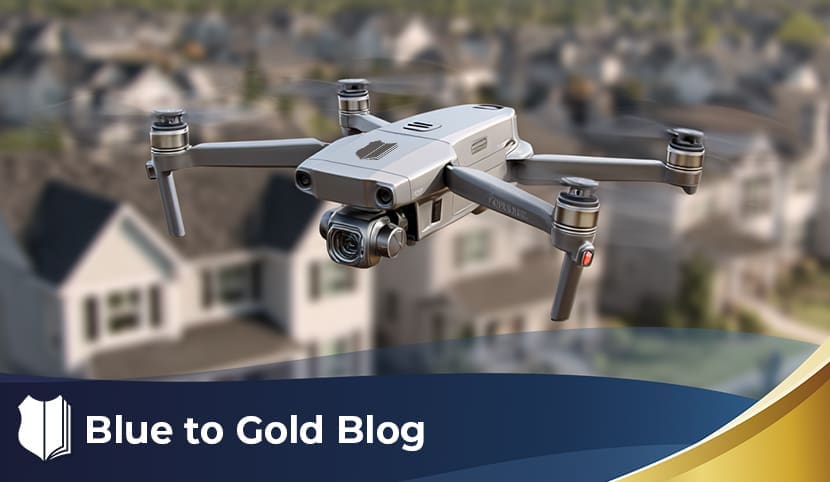
The analysis changes quickly when the drone is no longer passing overhead but is hovering directly above a home’s curtilage. Picture a drone sitting roughly 30 feet above a backyard, close enough to feel personal, clearly equipped with a camera, marked as a government aircraft, and visibly intrusive. Most people would be offended by that. That reaction matters in Fourth Amendment analysis.
A recent Michigan case illustrates the issue. In that case, the government flew drones over residential curtilage to photograph junk vehicles as part of civil enforcement. The court concluded that flying a drone over the curtilage for that purpose constituted a search under the Fourth Amendment. Traditionally, curtilage has been defined by proximity to the home and use of the area. As technology advances, courts are now being forced to consider whether curtilage also has a vertical dimension.
We already know that flying high overhead in navigable airspace is generally not a search. But drones operate much lower, and that lower altitude changes the nature of the intrusion. The concept begins to resemble a vertical box around the home rather than a flat area on the ground. At some point, that box becomes protected.
This idea is not new. Long before drones existed, courts addressed similar issues when airplanes first became common. Early landowners argued they owned all the airspace above their property. The Supreme Court rejected that view. However, other cases recognized that low-flying aircraft could interfere with a person’s right of enjoyment of their land. When aircraft flew so low and so often that people could not reasonably enjoy their property, the law took notice.
That same reasoning applies to drones. The question becomes: at what point does a drone intrude on a person’s right of enjoyment of their property? Drones are inherently invasive. They are visible, they are noisy, and everyone knows they carry cameras. When people cannot sit in their backyard, have a conversation, or relax without feeling watched, the intrusion becomes real.
Some states have attempted to address this issue through statutes. Nevada, for example, has set minimum flight altitudes for drones. Under Nevada law, drones generally cannot fly below a specified altitude over private property. While the exact application may extend beyond law enforcement, the underlying idea is clear: there is a lower boundary where drone flight becomes too intrusive.
For officers, the takeaway is not that drones are prohibited, but that they are legally sensitive tools. When a government drone is flown low over curtilage for the purpose of gathering evidence, it may cross the line into a Fourth Amendment search. A useful question to ask is whether the drone’s presence interferes with the occupant’s reasonable enjoyment of their property. When the answer is yes, the constitutional risk increases significantly.