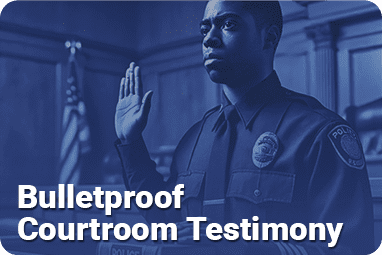


When Telling the Truth Isn’t Enough: The Overlooked First Step in Preparing for Court
By Jessica Walsh, Legal Instructor, Blue to Gold
Prosecutors are often asked, “What is the single most important thing an officer can do to prepare for courtroom testimony?” The answer most frequently given is simple: just tell the truth. While accurate, it is rarely helpful as most officers already intend to do exactly that.
Inside a courtroom, telling the truth and being perceived as credible by a judge and jury are not always the same thing.
The first step in preparing for court is not deciding whether to tell the truth, but learning how to present that truth in a way that six or twelve strangers can understand, trust, and believe.
Jurors do not know you. They do not know your reputation or your work ethic. All they have is what they see and hear in that courtroom. Your words, demeanor, preparation, and confidence influence whether jurors view you as a credible professional.
In Blue to Gold’s latest publication, After the Arrest: An Officer’s Guide to the Criminal Justice System and Preparing for Effective Courtroom Testimony, I spend significant time breaking down how juries interpret officer testimony and how law enforcement professionals can avoid the small missteps or mistakes that quietly undermine otherwise strong cases.
Now that we understand what truly matters most in courtroom testimony, the next question is how to accomplish it.
And that does not come from a single trick. It comes from a working knowledge of the judicial system, intentional preparation, and the cultivation of deliberate habits, one of which is often the most overlooked and simplest to master.
Master Your Introduction
Even officers brand new to policing have likely used the phrase, “In my training and experience,” but before jurors can evaluate how you relied on that training and experience, they must first be given a clear picture of what that training and experience actually are.
That is why, when you take the stand, you will begin your testimony with a familiar series of introductory questions designed to establish who you are, how you were trained, and the experience you bring to the case.
- Where are you employed?
- How long have you been an officer?
- When did you graduate from the academy?
- How long have you been in your current assignment?
- What units have you worked in?
- How many investigations have you conducted in this area?
These are easy questions—unless you are unprepared. Officers who do not expect them often pause, calculate dates in their heads, hedge their answers, or stumble over timelines. And jurors notice every second of it.
When a jury sees an officer struggle with basic questions such as “When did you transfer to robbery?” or “When did you graduate from the academy?” how can they be expected to have confidence in later testimony on far more complicated matters? These early stumbles, often dismissed as insignificant, can quietly mark the beginning of the end of the witness’s credibility.
That reaction is human. Jurors expect professionals to know their own careers, and they often assume officers testify regularly. Jurors have no way of knowing whether this is your first time testifying or your hundredth, which is why you must be prepared to move confidently through these introductory questions.
Calm Your Nerves
Testifying in court, even for the most seasoned detectives, can be intimidating. Nerves are natural. Yet the advice most often given to anxious officers, “just calm down,” “don’t be nervous,” or “be prepared,” is rarely helpful when nerves are running so high that your first goal is simply to remember your own name once all eyes are on you.
And why wouldn’t you be a bit nervous? This is not just about upholding the integrity of your investigation. It is about serving your community. It is about seeking justice for those who were harmed. And in some cases, it is about speaking for those who can no longer testify for themselves.
So should you simply will your nerves away and hope for the best? Of course not. Only Kendrick Lamar seems capable of handling “all eyes on me” by sending it up to Pac. Most of us need a better plan.
A more useful approach is to accept that anxiety is part of the process and focus instead on what you can control: proper preparation. Being able to confidently answer introductory questions gives your nerves a chance to settle. It allows you to get into a steady rhythm with your prosecutor so that by the time testimony turns to the substance of your investigation, you are already operating from a place of confidence rather than defensiveness.
If you are still concerned about nerves, have someone run through your training and experience with you. Out loud. Repeatedly. You can find a comprehensive list of common introductory questions in After the Arrest.
When those questions feel automatic, your brain is freed to focus on the substance of the case rather than managing anxiety. Jurors expect you to answer calmly, just as you would in any normal conversation. Proper preparation simply helps you meet that expectation under pressure.
Parting Words
If you found this information helpful, explore Blue to Gold’s latest publication, After the Arrest: An Officer’s Guide to the Criminal Justice System and Preparing for Effective Courtroom Testimony, which provides officers with a working understanding of the justice system and the tools needed to testify clearly, confidently, and credibly.
And just maybe, I will see you in court.