
Is Florida’s Plain Smell Doctrine Getting Vaporized?
Under the Totality of the Circumstances, Establishing Probable Cause for Warrantless Car Search Under the Automobile Exception, Likely Requires More than the Odor of Marijuana
Overview
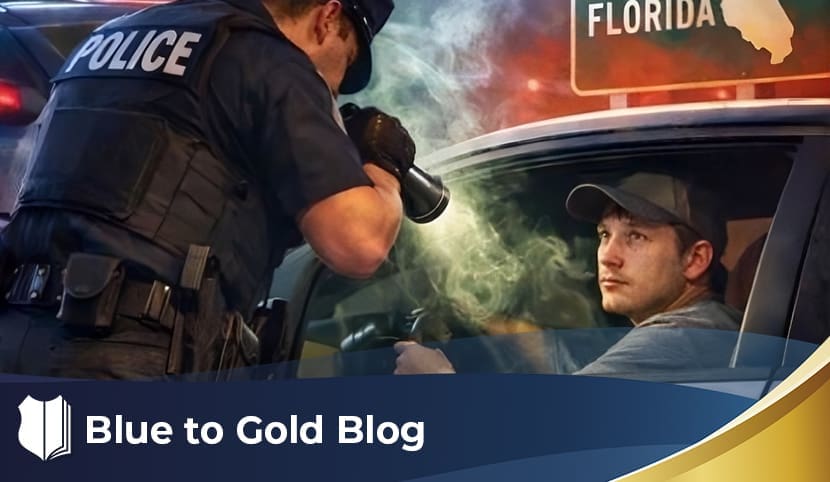
Establishing probable cause to search a vehicle, and reasonable suspicion for an investigatory stop, likely require more than the smell of raw or burnt marijuana. Florida courts have held that, due to the legalization of hemp (low-THC cannabis), the smell or sight of marijuana is no longer plainly criminal. Probable cause is established based on the totality of the circumstances considering factors such as signs of intoxication, incriminating statements, or elimination of innocent explanations.
Doctrines Underpinning Warrantless Car Searches
Under the automobile exception, “police may search a [readily mobile] vehicle without a warrant so long as they have probable cause to believe that it contains contraband or evidence of a crime.” Described as a fair probability, “probable cause exists where the facts and circumstances within the officer’s knowledge” would “warrant a man of reasonable caution in the belief that an offense has been or is being committed.”
Under the plain view doctrine, “if police are lawfully in a position from which they view an object, if its incriminating character is immediately apparent, and . . . have a lawful right of access to the object, they may seize it without a warrant.” In Minnesota v. Dickerson, the U.S. Supreme Court explained that “if contraband is left in open view and is observed by a police officer from a lawful vantage point, there has been no invasion of a legitimate expectation of privacy.” The item must “clearly [be] incriminating evidence or contraband” without requiring further search. Plain view—“right to be, right to see”—has been expanded to describe plain feel and plain smell doctrines. Yet, Florida courts have held that the odor of cannabis is no longer plainly criminal due to the legalization of hemp, which looks and smells identical to marijuana.
Cannabis is No Longer Plainly Criminal Amid Legalization of Medical Marijuana and Hemp (Low-THC Cannabis)
While recreational marijuana remains illegal in Florida, cannabis is legal when (1) properly “dispensed from a medical marijuana treatment center;” or (2) it is hemp. While Florida prohibits using medical marijuana in a vehicle, hemp is not a controlled substance and may be smoked while driving similar to tobacco. Florida statutes require that law enforcement be able to access the medical marijuana use registry to confirm whose possession is authorized.
Florida construes its state constitutional protection against unreasonable search and seizure in accordance with U.S. Constitutional interpretation of the Fourth Amendment. Florida’s six district courts of appeal recently analyzed how the odor of marijuana may contribute to establishing probable cause for warrantless car search under the automobile exception. The majority hold that probable cause requires more than the odor of marijuana, which may be considered as one factor under the totality of the circumstances.
First District
In Hatcher v. State (2022), police stopped a van due to erratic driving including veering outside the lane, traveling through parking spaces, and nearly striking a sidewalk curb. Appearing “unusually relaxed and lethargic” during the stop, the driver lacked a license and admitted he “just smoked a blunt and discarded it before the traffic stop.” The officer believed “blunt” meant a marijuana—not a hemp—cigarette, also noting signs of intoxication. A K-9 sniffed the van, alerting at the driver’s door. Subsequent search revealed a “digital scale with a leafy green residue on it and pills that were believed to be MDMA [ecstasy].” The Court held that probable cause existed to believe the driver “was under the influence of marijuana he had smoked while driving,” with the odor of burnt marijuana serving as just one factor contributing to “the whole picture.” The defendant’s argument—that the smell of marijuana alone is insufficient for vehicle search—was beside the point, because probable cause was established based on the totality of the circumstances.
Second District
In Williams v. State (2025), police stopped a car for traffic violations, in which Mr. Williams, who was on probation, was a passenger. The two officers detected the odor of cannabis emanating from the car, disagreeing on whether it smelled burnt or fresh. Solely based on this smell, police searched the vehicle, finding bags of cannabis and a pill in the glove box. Upon arrest, a search of Mr. Williams revealed dimethylpentylone, a controlled synthetic stimulant, hidden in his sock.
The Court held that, due to the legalization of hemp, “the plain smell doctrine can no longer establish probable cause based solely on the odor of cannabis;” the totality of the circumstances governs.
In Cherfils v. State (2025), police stopped a vehicle in a high-crime area due to an improperly lit license plate, and smelled burnt marijuana emanating from the driver. The driver presented his medical card, supporting the reasonable inference that he was impermissibly smoking marijuana—not hemp—while driving. While the driver stated he had smoked marijuana earlier that day, the officer described that the odor was palpable to a greater degree, suggesting smoking while driving. The driver’s conduct—described as nervous, evasive, dishonest, and argumentative, including refusal to exit the car—compounded the fair probability that he was illegally smoking in his vehicle. The search revealed contraband in the car side door, and the driver was charged with possession of cocaine with intent to sell. The Court held that probable cause, described as “more than a mere possibility,” was established under the totality of the circumstances.
Conclusion
Hemp (low-THC cannabis) provides a legal explanation for the sight and odor of marijuana, which look and smell identical. Thus, the smell of either burnt or raw (fresh) marijuana is no longer plainly criminal, but may be one factor among others contributing to probable cause for warrantless car search. The totality of the circumstances remains the standard for establishing probable cause, with many courts holding that—standing alone—a sniff is not “up to snuff.”
References
- “Because the ‘plain smell’ of cannabis is no longer clearly indicative of criminal activity, it alone cannot provide reasonable suspicion to support an investigatory detention.” Williams v. State, 421 So.3d 809, 813 (Fla. 2nd DCA 2025); Baxter v. State, 389 So.3d 803, 806 (Fla. 5th DCA 2024).
- FLA. STAT. § 581.217(2)(a)–(b); 21 U.S.C. § 802(16)(B)(i) (excluding hemp from the federal definition of marijuana).
- The totality of the circumstances “allows officers to draw on their own experience and specialized training to make inferences from and deductions about the cumulative information available to them that ‘might well elude an untrained person.’” State v. Fortin, 383 So.3d 820, 822–23 (Fla. 4th DCA 2024) (quoting Hatcher v. State, 342 So.3d 807, 810 (Fla. 1st DCA 2022)).
- Hatcher, 342 So.3d at 809 (“Based on the sergeant’s training and experience, he believed that [the driver’s] laidback and lethargic demeanor suggested that he was under the influence of marijuana. The sergeant also smelled the odor of burnt marijuana coming from inside the van,” stopped due to erratic driving).
- Id. at 811 (“[T]he driver “admitted that he had just smoked a blunt and discarded it before the traffic stop. The officer believed that ‘blunt’ meant a marijuana cigarette, not a hemp cigarette”—contributing to probable cause).
- See Aldama v. State, 394 So.3d 148 (3rd DCA 2024) (“[T]he totality of the circumstances provided . . . probable cause to . . . search [the car] upon the plain smell of marijuana and the dispelling of any lawful explanations.”).
- Id. at 150; Hatcher, 342 So.3d at 810 (citing Pennsylvania v. Labron, 518 U.S. 938, 940 (1996)).
- Fortin, 383 So.3d at 822–23.
- Minnesota v. Dickerson, 508 U.S. 366, 375 (1993) (plain feel doctrine).
- Washington v. Chrisman, 455 U.S. 1, 5–6 (1982).
- United States v. Angelos, 433 F.3d 738, 747 (10th Cir. 2006) (reviewing the plain smell doctrine).
- The “legalization of certain types of cannabis at both the federal and state level has reached the point that its plain smell does not immediately indicate the presence of an illegal substance.” Baxter v. State, 389 So.3d 803, 810–11 (Fla. 5th DCA 2024); Ford v. State, 400 So.3d 838, 843 (Fla. 5th DCA 2025).
- Hatcher, 342 So.3d at 810 n.3 (quoting FLA. STAT. § 581.217(3)(d)).
- FLA. STAT. § 381.986(1)(k)5.f (prohibiting use of medical marijuana [i]n a school bus, a vehicle, an aircraft, or a motorboat.”). “While it is not illegal to smoke hemp in a vehicle, medical marijuana users are prohibited by criminal statute from using medical marijuana by smoking it in a vehicle.” Cherfils v. State, No. 2D2023-1932 (2nd DCA Dec. 31, 2025) (citing FLA. STAT. § 581.217).
- FLA. STAT. § 581.217(3)(e) (“‘Hemp’ means the plant Cannabis sativa L. and any part of that plant . . . that has a total delta-9-[THC] concentration that does not exceed 0.3 percent.”).
- FLA. STAT. § 381.986(5)(a) (“The medical marijuana use registry must be accessible to law enforcement agencies.”).
- FLA. CONST. art. I, § 12; see also Aldama, 394 So.3d at 150.
- Hatcher v. State, 342 So.3d 807 (Fla. 1st DCA 2022) (“Based on the officer’s observations, training, and experience, as well as [the driver’s] statements and demeanor, the officer reasonably believed that [he] was under the influence of marijuana he had smoked while driving.”).
- Williams v. State, 421 So.3d 809 (Fla. 2nd DCA 2025) (“Because the ‘plain smell’ of cannabis is no longer clearly indicative of criminal activity, it alone cannot provide reasonable suspicion to support an investigatory detention.”) (quoting Baxter, 389 So.3d at 806).
- Absent court-ordered conditions, Florida law allows probation officers (not law enforcement generally) to search individuals on probation. Williams, 421 So.3d at 848 n.2).
- Cherfils v. State, No. 2D2023-1932 (Fla. 2nd DCA Dec. 31, 2025) (“The totality of the circumstances,” including the driver’s dishonesty “as to the nature of the odor, his evasive responses to law enforcement questioning, his nervous and argumentative disposition, and evidence that the type of cannabis [medical marijuana] was not legal to smoke in a vehicle—provided . . . more than a mere possibility that an offense had been or was being committed.”).
- “[H]emp and marijuana are indistinguishable by sight or smell.” Hatcher, 342 So.3d at 810 n.3.
- Baxter, 389 So.3d at 812 (The “smell of cannabis may be a relevant, but not dispositive, factor to consider under the totality of the circumstances.”).
- See Hoehaver, 389 So.3d at 768 (Kilbane, J., concurring) (The officer “developed probable cause based on the totality of the circumstances.”).
- Ford, 400 So.3d at 840–41 (“Is the undifferentiated alert behavior of a . . . drug-sniffing dog sufficient to supply the sole probable cause for a warrantless search of a car, when that K-9 . . . cannot distinguish between illegal pot and legal medical marijuana or hemp? In other words, is that sniff up to snuff? Going forward, that dog won’t hunt.”).