
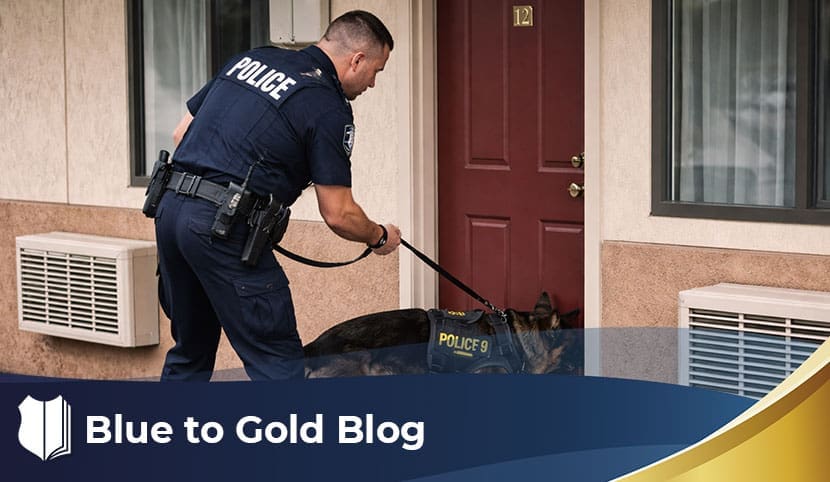

Officers investigating suspected narcotics activity may consider deploying a trained drug-detection dog in the hallway of a multi-unit building to sniff along exterior doors. The legal question is whether a K-9 sniff conducted from a motel or hotel hallway constitutes a Fourth Amendment search, and whether the same tactic in an apartment hallway outside a resident’s door is lawful.
Fourth Amendment analysis generally proceeds under two theories: a property-based approach focusing on trespass into a constitutionally protected area, including curtilage, and the traditional reasonable-expectation-of-
In the hotel and motel context, courts have consistently held that common hallways, walkways, and alcoves outside guest rooms are not curtilage and do not create a reasonable expectation of privacy that would bar a canine sniff. No known court has held that officers may not conduct a K-9 sniff from a hotel or motel hallway outside a room door.
People v. Lindsey, 2020 IL 123331 (Ill. 2020), is illustrative. Officers received information that the defendant was selling narcotics from a motel room. After the defendant was arrested during a traffic stop, a K-9 conducted a “free air sniff” in the alcove outside the motel room and alerted “within inches of the door.” A search warrant was obtained, narcotics were recovered, and the defendant moved to suppress. The Illinois Supreme Court reinstated the conviction. The court explained that the government violates the Fourth Amendment either by a warrantless intrusion onto a person’s property or by a warrantless infringement of a person’s societally recognized privacy. Even assuming the motel room functioned as the defendant’s home, the alcove outside it was not curtilage because it was not put to the defendant’s personal use, and he had “no ownership or possession of the alcove, only a license to use it.” The court further concluded that the defendant had no reasonable expectation of privacy in that alcove. The K-9 sniff from that location was therefore not a search requiring a warrant.
Federal courts have reached similar conclusions. In United States v. Legall, 585 F. App’x 4, 5–6 (4th Cir. 2014), the court held that “the common hallway of the hotel was not within any curtilage of the hotel room.” The court rejected a privacy-based challenge, quoting Illinois v. Caballes, 543 U.S. 405, 409 (2005): “The use of a well-trained narcotics-detection dog—one that ‘does not expose noncontraband items that otherwise would remain hidden from public view—during a lawful traffic stop, generally does not implicate legitimate privacy interests.’ ” It further emphasized that “ ‘[t]he legitimate expectation that information about perfectly lawful activity will remain private is categorically distinguishable from [a person’s] hopes or expectations concerning the nondetection of contraband.’ ” Id. at 410. Because the dog disclosed only the presence of illegal narcotics, no Fourth Amendment search occurred.
The primary legal uncertainty arises in the apartment context. Jardines does not automatically resolve the apartment-hallway issue because the area outside an apartment door in a multi-tenant building will rarely qualify as curtilage under Dunn. As a result, courts often focus on whether a resident has a reasonable expectation of privacy in the common hallway.
Some courts hold that there is no reasonable expectation of privacy in common hallways and that a dog sniff there is not a search. In State v. Nguyen, 2013 ND 252, 841 N.W.2d 676, the court held that the defendant did not have a reasonable expectation of privacy in the common hallways of his apartment building and that the use of a drug-sniffing dog in that hallway did not constitute a search under the Fourth Amendment.
Other courts emphasize the heightened constitutional protection afforded to the home. In United States v. Thomas, 757 F.2d 1359, 1367 (2d Cir. 1985), the court explained that “a practice that is not intrusive in a public airport may be intrusive when employed at a person’s home,” and concluded that the defendant “had a legitimate expectation that the contents of his closed apartment would remain private, that they could not be ‘sensed’ from outside his door. Use of the trained dog impermissibly intruded on that legitimate expectation.” More recently, in State v. West, No. A25A1819, 2026 WL 72634 (Ga. Ct. App. Jan. 9, 2026), the court held that “Use of drug dog to sniff ‘the entire seal’ of defendant’s apartment door to gain information about the contents of his home violated his reasonable expectation of privacy and was therefore an illegal warrantless search.”
The prevailing authority strongly supports the lawfulness of hotel and motel hallway sniffs when officers are lawfully present in common areas. The focus of litigation lies with apartment hallways. Because most apartment hallways are not curtilage, the decisive issue is whether courts in the relevant jurisdiction recognize a reasonable expectation of privacy against a K-9 sniff at the apartment door.
In jurisdictions that follow Caballes and similar reasoning, a hallway sniff that reveals only contraband is not a search. In jurisdictions that follow Thomas or West, a focused canine sniff at the threshold of a residence may be treated as a warrantless search. Officers considering a K-9 deployment in an apartment hallway should review controlling local precedent and consult with their prosecutor before proceeding.
The bottom line is clear. Hotel and motel hallway sniffs are well supported by case law, and no known court has prohibited that practice. Apartment hallway sniffs remain jurisdiction-specific and require careful legal review before deployment.
If I was a betting man, I think the U.S. Supreme Court will uphold sniffing apartment hallways and adjacent doors if the area is not considered curtilage. It will also help if the police are not committing a trespass and have permission to be in the area, though this may not be necessary if the area is considered open fields (see Dunn). But again, check with your prosecutor.