
How Are Colorado Courts Handling Cannabis, K-9s, and Car Searches?
Overview
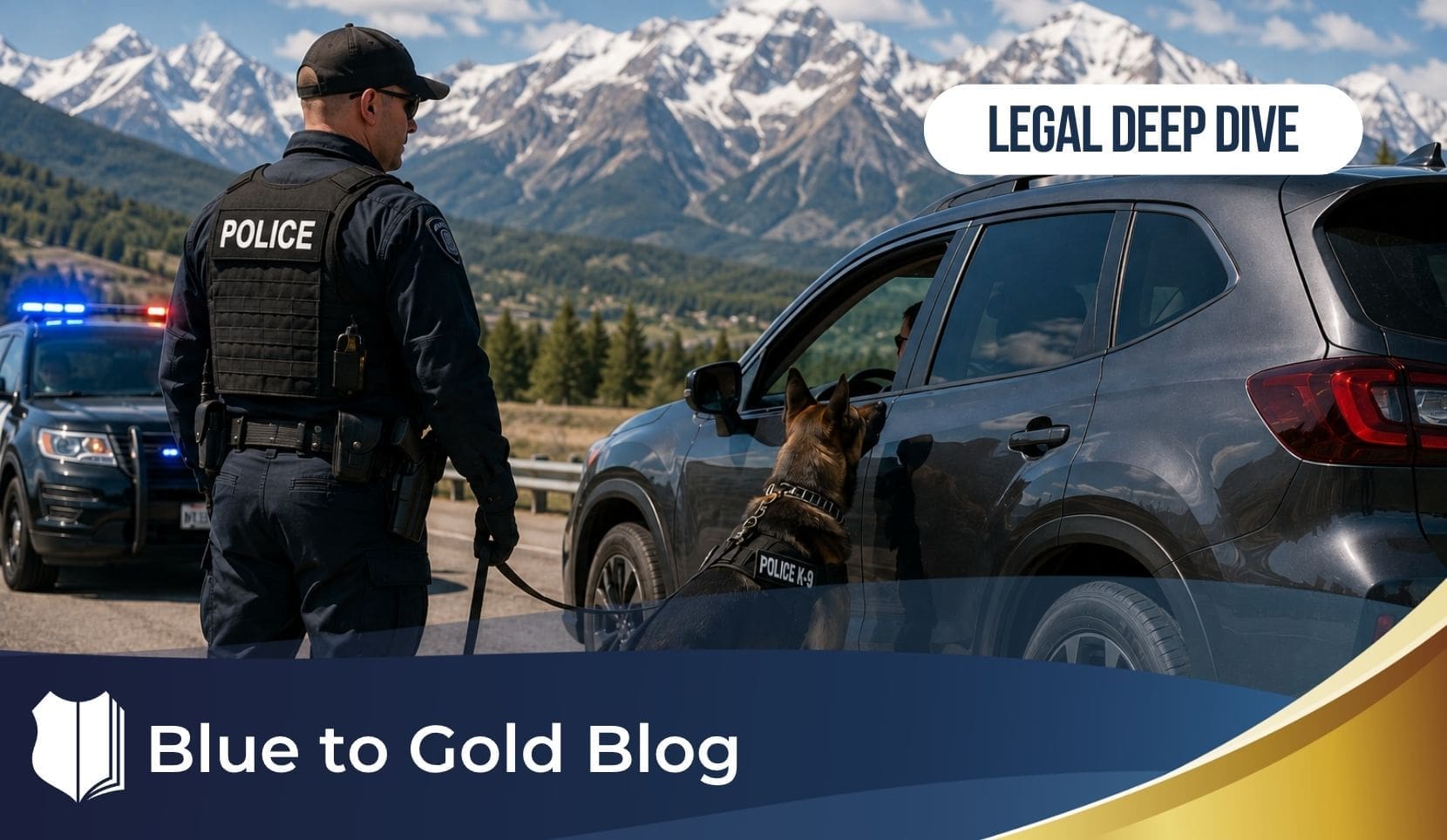
The Colorado Constitution, Amendment 64 legalizes possessing up to 1 ounce of marijuana by individuals aged 21 or over. Thus, adults in Colorado have a reasonable expectation of privacy in possessing the amount legal under State law. As a result, the Colorado Supreme Court held that probable cause is required to deploy a K-9, trained to alert to marijuana, for an exploratory sniff. For a sniff of a vehicle exterior, by a dog not trained to alert to marijuana, the “critical question” is whether the stop is prolonged, which requires reasonable articulable suspicion. Placing a K-9 inside a suspect’s car, even if not trained to alert to marijuana, is a search requiring probable cause.
Protected Privacy Interest in Lawful Marijuana Possession under the Colorado Constitution
“The Fourth Amendment to the United States Constitution and article II, section 7 of the Colorado Constitution prohibit unreasonable searches and seizures.” By legalizing possession up to 1 ounce of marijuana, Colorado provides “a state constitutional right not guaranteed by the federal constitution.” Acknowledging the reasonable expectation of privacy in lawful possession, the Colorado Supreme Court was the “first court to opine [that] the sniff of a dog trained to detect marijuana in addition to other substances is a search under a state constitution.”
Probable Cause: Required for Warrantless Search under the Automobile Exception
A “warrantless search is invalid unless it is supported by probable cause and is justified under one of the narrowly defined exceptions.” Under the automobile exception, where “an officer has lawfully stopped a vehicle, and has probable cause to believe [it] contains evidence of a crime, then the officer may conduct a search of the car without first obtaining a warrant.” Probable cause “consider[s] the totality of the circumstances to determine ‘whether a fair probability exists that a search of a particular place will reveal contraband or evidence of a crime.’”
People v. McKnight (2019): Colorado Supreme Court Holds that Probable Cause is Required Before Deploying a K-9 Trained to Alert to Marijuana
Police observed a truck parked the wrong way in a one-way alley, with a man standing outside the vehicle. Officers followed the truck, which then parked in front of a home where police had found drugs nearly 2 months prior. No one got in or out of the truck nor the home for the approximate 15 minutes the driver remained parked there. When the truck made a U-turn without signaling, police initiated a traffic stop. Police “recognized the passenger as someone who had used methamphetamine ‘at some point in the past,’ but he wasn’t sure how recently.” A K-9 trained to alert to marijuana was deployed, and indicated the presence of narcotics. Search revealed a pipe containing methamphetamine residue. The Court held there was no probable cause, reasoning that the driver’s “decision to park near the house tells us little, considering that almost two months had passed since drugs were found there,” and at the time, “no one exited the truck or the house.”
The Court reasoned that “(1) proximity to a house in which drugs had been found nearly two months earlier, and (2) the presence of [a passenger] who ‘at some point’ had used an illegal drug” was insufficient for probable cause. The Court held: “In Colorado, law enforcement officers must have probable cause to believe that an item or area contains a drug in violation of state law before deploying a drug-detection dog that alerts to marijuana for an exploratory sniff.”
People v. Bailey (2018): Colorado Supreme Court Upholds Probable Cause to Search Based on Initial Alert by K-9 Not Trained for Marijuana, in Conjunction with Other Circumstances
Police approached the defendant at a gas station after observing him go back and forth from his car to the convenient mart, as well as repeatedly move his vehicle to different locations at the gas station. Although the driver was initially free to go, his car battery was dead; thus, no reasonable suspicion was required yet, as he remained of his own volition. A K-9, not trained for marijuana, sniffed the car exterior and gave an initial alert. Search revealed over 6 pounds of marijuana and “a white powdery substance.” The Court clarified that the sniff outside the car was not a search, but placing the K-9 inside the vehicle was a search, supported by probable cause. Although police “did not notice any unlawful behavior,” these facts created “a legitimate inference of criminal activity” under the totality of the circumstances:
- The car (1) overwhelmingly smelled of air freshener; (2) belonged to a third party; and (3) had out-of-state tags in a known drug trafficking corridor;
- The driver (4) entered and exited a gas station mart multiple times, sat in his car for an extended period, and watched police through the mirror; and (5) “had an outstanding, nonextraditable arrest warrant out of California for possession of a concealed weapon;”
- The driver (6) appeared unusually nervous as his hands were “shaking badly;” (7) stated he was returning home to Iowa after a convention in Las Vegas; but was unable to show lodging documentation or corroborating business cards; and (8) claimed he left Iowa 3 days ago, rendering his alleged timetable nearly impossible; and
- (9) a K-9, not trained to react to marijuana, alerted during his first pass outside the car.
People v. Gamboa-Jimenez (2022): Colorado Court of Appeals Upholds Probable Cause to Deploy a K-9 (Not Trained to Alert to Marijuana) Inside a Vehicle
Police stopped a vehicle for traveling in the highway passing lane, and “articulated numerous reasons to suspect that [the driver] and his companion were transporting narcotics” before deploying a K-9. The Court reiterated that a sniff of the vehicle exterior, by a K-9 not trained to alert to marijuana, is not a search, but requires reasonable articulable suspicion to extend the stop. Search of the defendant’s car ultimately revealed more than a kilogram of cocaine. The K-9’s entry into the car was properly supported by probable cause where:
- (1) the driver began traveling 5 miles under the speed limit after seeing police; (2) occupants appeared exceptionally nervous including “hands shaking;”
- The car contained (3) the “overwhelming scent of air fresheners;” and (4) four cell phones;
- The car was (5) driven 30,000 miles in under a year; and (6) owned by a third party; and
- Occupants claimed (8) to be returning from a short trip to Las Vegas yet no luggage was visible; and (9) they had not gotten a hotel room during their travels.
People v. Lopez (2022): Court of Appeals Holds No Probable Cause for Sniff by K-9 Trained to Alert to Marijuana
Police stopped the defendant for driving without valid registration and failing to use a turn signal. He (1) displayed exceptional nervousness; (2) was driving an unregistered vehicle after being released from prison on bond for a narcotics case; and (3) claimed to be in Colorado Springs to do construction work despite wearing “‘clean clothes, an ironed shirt, and ‘designer shoes’” while “accompanied by a female passenger.” After observing these factors, police deployed a K-9 trained to alert to marijuana among other narcotics. The Court held that these factors “failed to convince us that probable cause supported the dog sniff,” and deploying the K-9 (trained to alert to marijuana) violated the Colorado Constitution.
People v. Gadberry (2019): Colorado Supreme Court Holds No Probable Cause for Sniff by K-9 Trained to Alert to Marijuana
Police stopped a vehicle for missing a front plate, ultimately found shoved into the grill, “although the car was still improperly registered.” The officer was aware that the car had been stopped a few days prior for incorrect registration and invalid tags. A K-9, trained to alert to marijuana among other narcotics, was deployed to sniff the car exterior. The Court reiterated that where a K-9 is “trained to alert to marijuana, the officers needed probable cause that the vehicle contained a drug in violation of state law before conducting the exploratory sniff.” It made no difference that the driver replied “no” when asked if there was marijuana in the car. The privacy interest in activity legal under state law required probable cause for a sniff by a K-9 trained for marijuana.
Conclusion
In Colorado, adults have a reasonable expectation of privacy in possessing up to 1 ounce of marijuana, permitted under State law. Thus, the Colorado Supreme Court held that a sniff by a K-9 trained to alert to marijuana is a search under the State Constitution, requiring probable cause. Although the sniff of a vehicle exterior, by a K-9 not trained to alert to marijuana is not a search, reasonable articulable suspicion is required to extend the stop.4 Placing a K-9, even if not trained for marijuana, inside a suspect’s vehicle is a search requiring probable cause.
References
- Colo. Const. art. XVIII § 16(3). Marijuana “is legalized, regulated, and taxed . . . treated like guns, alcohol, and tobacco” under State law. People v. McKnight, No. 17SC584 ¶ 42 (Colo. 2019); see Colo. Rev. Stat. § 42-4-1305.5.
- “In legalizing marijuana for adults, . . . Amendment 64 expanded the protections of article II, section 7 to provide a reasonable expectation of privacy . . . in the lawful activity of possessing marijuana in Colorado.” McKnight, at ¶ 42.
- In Colorado, officers “must have probable cause to believe that an item or area contains a drug in violation of state law before deploying a drug-detection dog that alerts to marijuana for an exploratory sniff.” Id. at ¶ 7.
- The “‘critical question’ is whether a dog sniff ‘prolongs’ a stop. If so, the officer must have reasonable suspicion of criminal activity—in addition to that which initially supported the traffic stop—to justify detaining the suspect.” People v. Gamboa-Jimenez, No. 18CA1516 ¶ 44 (Colo. App. Ct. Div. V 2022).
- People v. Bailey, 427 P.3d 821, 829 (Colo. 2018) (“Because the totality of the circumstances established reasonable grounds to believe [the] car contained narcotics,” police had probable cause to search when they placed the K-9 inside).
- Id. at 826 (citing Mendez v. People, 986 P.2d 275, 279 (Colo. 1999)); see also Colo. Const. art. II § 7.
- People v. McKnight, No. 17SC584 ¶ 41 (Colo. 2019); see also Colo. Const. art. XVIII.
- McKnight, at ¶ 42 (“Although possession of guns, alcohol, and tobacco can be unlawful, persons still maintain an expectation of privacy in lawfully using or consuming those items. The same now goes for marijuana.”)
- McKnight, at ¶ 47 (“Though we are the first court to opine on whether the sniff of a dog trained to detect marijuana . . . is a search under a state constitution in a state that has legalized marijuana, we probably won’t be the last.”).
- People v. McKnight, No. 17SC584 ¶ 50 (Colo. 2019) (quoting Mendez v. People, 986 P.2d 275, 279 (Colo. 1999)).
- McKnight, at ¶ 24 (citing Collins v. Virginia, 138 S. Ct. 1663, 1670 (2018)) (clarifying that “the automobile exception does not permit the warrantless entry of a home or its curtilage in order to search a vehicle therein.”).
- Id. at ¶ 51 (The probable cause “standard does not ‘lend itself to mathematical certainties,’ and, instead, ‘is based on factual and practical considerations . . . on which reasonable and prudent people, not legal technicians, act.’”).
- People v. McKnight, No. 17SC584 (Colo. 2019) (“hold[ing] that a sniff from a drug-detection dog that is trained to alert to marijuana constitutes a search [requiring probable cause] under . . . the Colorado Constitution because that sniff can detect lawful activity, namely the legal possession of up to one ounce of marijuana by adults.”).
- An “inference that persons who talk to narcotics addicts are engaged in the criminal traffic in narcotics [alone] is simply not the sort of reasonable inference required to support” probable cause. McKnight, at ¶ 57.
- Citing People v. Miller, 75 P.3d 1108, 1114–15 (Colo. 2003) (“concluding that information about alleged criminal activity that was nearly a month old was too ‘stale’ to provide probable cause for a search warrant.”).
- Citing Outlaw v. People, 17 P.3d 150, 157 (Colo. 2001) (“reject[ing] the notion that ‘a history of past criminal activity in an area is itself sufficient to create a reasonable suspicion that a crime is being . . . committed.’”).
- People v. Bailey, 427 P.3d 821 (Colo. 2018) (The K-9’s “initial alert, when considered in conjunction with other circumstances,” established “probable cause to believe that there were narcotics in [the suspect’s] car.”).
- An initial “alert, or a change in a dog’s behavior in reaction to the odor of drugs, is sufficient to establish probable cause to search a vehicle . . . a final indication was not required” where the K-9 was not trained for marijuana. Bailey, 427 P.3d at 828 (citing United States v. Moore, 795 F.3d 1224, 1232 (10th Cir. 2015)).
- “[P]lacing [the K-9] in his car was a search subject to protection under the Fourth Amendment to the United States Constitution and article II, section 7 of the Colorado Constitution,” supported by probable case. Id. at 827, 829.
- Id. Because police can “draw rational inferences from all the circumstantial evidence, we may not . . . discount acts simply because in isolation they may each have plausible innocent explanations.” Gamboa-Jimenez, at ¶ 40.
- People v. Gamboa-Jimenez, No. 18CA1516 (Colo. App. Ct. Div. V 2022) (“Because the totality of the circumstances established reasonable grounds to believe [the] car contained narcotics, the troopers had probable cause to search it when they placed [the K-9] inside” the suspect’s vehicle).
- A person shall not drive in the highway passing lane if the speed limit is 65 MPH or over unless (1) passing other cars; (2) turning left; or (3) traffic does not permit safely returning to a right lane. Colo. Rev. Stat. § 42-4-1013(1).
- “The critical question is whether a dog sniff prolongs a stop. If so, the officer must have reasonable [articulable] suspicion of criminal activity—in addition to that which initially supported the traffic stop—to justify detaining the suspect.” Gamboa-Jimenez, at ¶ 44 (quoting Rodriguez v. United States, 575 U.S. 348, 357 (2015)).
- “Assuming . . . that the dog’s entry into the car was a search, we conclude it was a reasonable one,” supported by probable cause, where police “articulated numerous reasons to suspect that [the defendant] and his companion were transporting narcotics.” Gamboa-Jimenez, at ¶ 52.
- Police testimony described “the scrupulous obedience of traffic laws after law enforcement is observed” as one factor, in conjunction with others, “associated with people involved in drug trafficking.” Gamboa-Jimenez, at ¶ 14.
- People v. Lopez, 518 P.3d 775 (Colo. Ct. App. Div. I 2022) (Probable cause for a sniff by a K-9 trained for marijuana lacked where the driver (1) was unusually nervous; (2) drove an unregistered car while on bond for a narcotics case; and (3) claimed to be in the area to work construction while “nicely dressed and accompanied by a female passenger.”).
- People v. Gadberry, 440 P.3d 449 (Colo. 2019) (Where the K-9 “was trained to alert to marijuana, the officers needed probable cause that the vehicle contained a drug in violation of state law before conducting the exploratory sniff”—lacking where defendant was suspected of driving an improperly registered vehicle with a missing front plate).
- “In legalizing marijuana for adults twenty-one and older, Amendment 64 expanded the protections of article II, section 7 [against unreasonable search and seizure] to provide a reasonable expectation of privacy to engage in the lawful activity of possessing marijuana in Colorado.” McKnight, at ¶ 42; see also Colo. Const. art. XVIII § 16(3)).
- A search occurs “when the government violates a subjective expectation of privacy that society recognizes as reasonable.” McKnight, at ¶ 9 (quoting Kyllo v. United States, 533 U.S. 27, 33 (2001)).
- Because adults in Colorado “may lawfully possess marijuana in small amounts, a drug-detection dog that alerts to . . . marijuana can no longer be said to detect ‘only’ contraband. Thus, an exploratory sniff of a car from a dog trained to alert to [marijuana] violates a person’s reasonable expectation of privacy” under the State Constitution. Id. at ¶ 43.