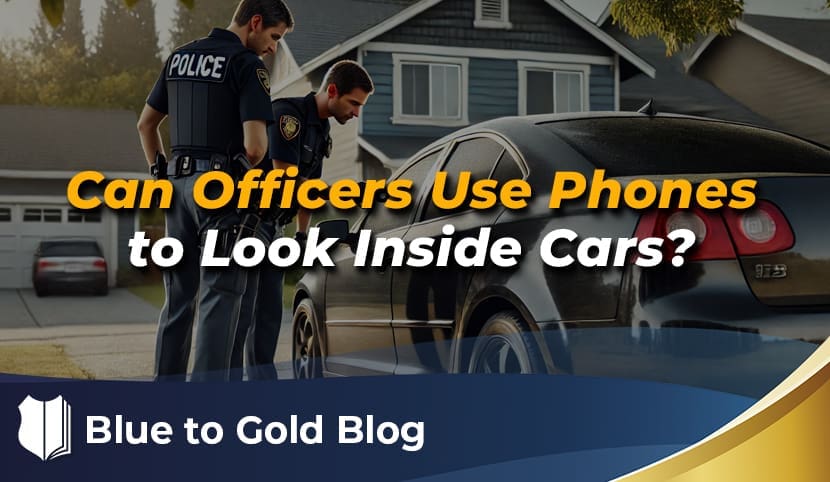

Officers were serving an arrest warrant at a suspect’s apartment. While at the location, they observed the suspect’s vehicle parked in a parking lot. The vehicle had tinted windows that prevented officers from seeing inside with the naked eye. An officer used a cell phone camera and held it up near the tinted window. By looking through the phone’s camera display, the officer was able to see inside the vehicle and observe firearms and other contraband.
According to the facts discussed, the officer initially hovered the phone near the window rather than physically touching the vehicle. Another officer later shaded the windshield with his hands to improve visibility. At some point, the phone may have physically contacted the vehicle. Based on what was observed through the phone, officers later obtained a warrant.
The legal question is whether using a cell phone to see through tinted vehicle windows constitutes a Fourth Amendment search, and whether the Second Circuit approved that practice.
Alright, now let’s talk about what the law is. There are two recognized ways government conduct can qualify as a Fourth Amendment search. One is when officers violate a person’s reasonable expectation of privacy. The other is when officers physically trespass on a constitutionally protected area with the intent to obtain information. The trespass-based test comes from United States v. Jones, 565 U.S. 400 (U.S. Supreme Court 2012).
Vehicles generally carry a reduced expectation of privacy because they are mobile and heavily regulated. Courts often consider what society is prepared to recognize as objectively reasonable when evaluating privacy claims involving vehicles. Tinting windows may reflect a subjective desire for privacy, but that does not automatically mean the expectation is one society recognizes as reasonable.
In the Second Circuit case discussed, Poehler v. United States, the court concluded that using a cell phone camera to look into a vehicle with tinted windows did not violate a reasonable expectation of privacy. The court reasoned that the presence of window tint did not create an objectively reasonable expectation of privacy in the vehicle’s interior.
On the trespass issue, the court did not squarely decide whether physically touching a vehicle with a phone to gather information would constitute a search. Instead, the court assumed for the sake of argument that even if physical contact with the vehicle using a phone were a search, the evidence ultimately relied upon was not the product of that contact. The court focused on the fact that the officer was able to observe the contents of the vehicle without physically intruding onto it.
Alright, with these facts and laws in mind, here is the answer. The Second Circuit allowed officers to use a cell phone camera to see into tinted vehicle windows when the phone was held near the glass and not physically intruding into the vehicle. Under Poehler, that conduct did not violate a reasonable expectation of privacy in the vehicle.
The decision does not clearly authorize officers to physically touch a vehicle with a cell phone to see inside. The court avoided deciding that issue and resolved the case on other grounds. That distinction matters. Hovering a phone near a window is treated differently than making physical contact with the vehicle for the purpose of gathering information.
Officers should be cautious about reading the case too broadly. Poehler supports the use of a phone to look into a vehicle without physical intrusion. It does not clearly approve physically touching a vehicle with a device to overcome visual barriers. Bottom line: the Second Circuit allowed officers to see into tinted windows using a cell phone camera when no physical trespass occurred, but it did not definitively approve touching the vehicle to do so.