
This question comes from an officer in Alabama.
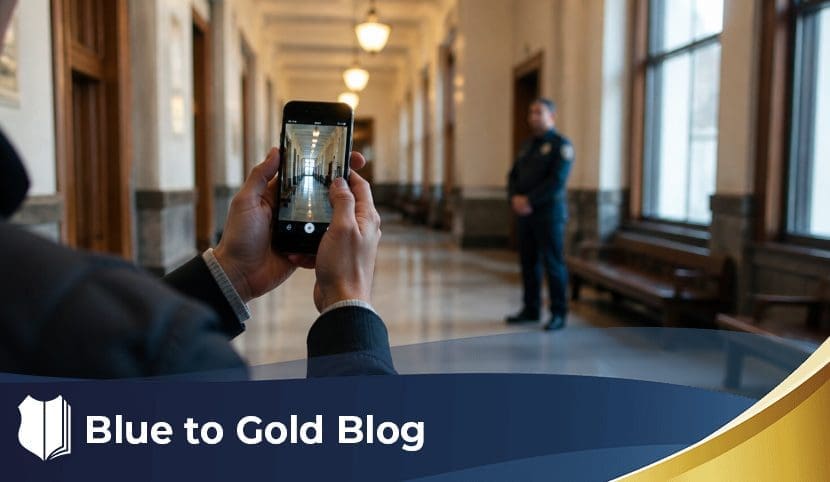
They have a judge who posted an order that there’ll be no cameras in the hallway. I gather they’re having auditors come into the courthouse with cameras, standing around filming, which draws attention to their eccentric behavior. But they’re uploading to YouTube, so there’s a purpose there. Get some likes, some subscribes.
Recently a circuit court judge posted an order that reads: no cameras in the magistrate’s office, per Judge So-and-So.
Okay. So this is a public office. The officer has sent the question to their attorney, and the DA has no answer. It can be complicated, and I understand that. I know a judge can issue orders for their courtrooms. But the officer is concerned. Is this okay? Is this too much?
They also cite the Alabama obstruction statute, and mention a similar scenario in Oklahoma and Georgia. In Oklahoma they did not throw them out. In Georgia the camera was prohibited for courtroom security purposes.
So what do I think?
First of all, let me make sure you know this is above our pay grade. This is just for conversation. These cases are very fact intensive, very complicated. The First Amendment is obviously highly litigated.
I like to say the First Amendment is also the most protected right. I would like to think the Fourth Amendment is. I would love to think the Second Amendment is very protected, and I’d love it to be the most protected personally, because without the Second Amendment it’s hard to have the First and the Fourth. But I digress.
The point is, the First Amendment is highly litigated and these are very fact-specific cases.
Can the First Amendment be restricted at all?
We do know the Supreme Court allows a certain amount of restriction, if it’s a time, place and manner restriction.
You can’t yell fire in a crowded theater. There may be restrictions on yelling religious speech in a neighborhood at three o’clock in the morning. But if they’re doing the same thing in a public forum at three in the afternoon, maybe they can’t restrict that.
I want to talk about a case from 1971. Cohen went into a California courthouse, maybe a courtroom too, wearing a jacket that said, and I’m going to tell you exactly, not “F the draft,” it actually said it. Kids were in there. Parents. People getting married. People going through their court proceedings. People with Selective Service obligations were in there.
A cop arrested Cohen and said look, this is vulgar, it’s disrupting courtroom procedure, people don’t like it, it’s immoral that you have this vulgarity on your jacket.
It goes all the way up to the Supreme Court. And essentially the Court said that was not allowed, because one man’s vulgarity is another man’s lyric.
Think about rap music today. Some of it can be extremely vulgar, but it has a message. There’s a lot of message in there.
Now, the Court of course left open the idea that there can be some restrictions in a courthouse. The whole courthouse is not a public square. But it is still a public building, and you’ve got to be careful with the First Amendment.
What authority does a judge actually have?
Judges generally have judicial authority to control the manner of how the courts operate.
Yes, they can make you take off your hat. Yes, they can have you stand up, if you’re able to stand, when the judge enters the room. And he can hold you in contempt if you break these rules. The rules are there to reinforce the formality and solemnity of the courthouse and the proceedings.
But the First Amendment does not stop at the steps of the courthouse. There is definitely a right to free speech inside.
I can certainly imagine a defendant who’s asked, do you want to say something on the record, and starts going into this diatribe about injustice and this and that, saying things that are offensive to the judge, maybe insulting the judge’s character. The judge should be very careful about saying well, you can’t say that.
As long as it’s related to the proceedings. Maybe they’re totally off topic and talking about UFOs and Martians. Then maybe you can say it, we just can’t say it right now, because we’re talking about your sexual assault trial. But if they want to talk about how the justice system is rigged, I would be very careful about shutting that person down.
Can cameras be restricted in a courtroom?
Yes. There’s a Supreme Court case from 1981, Chandler v. Florida, that said courts are allowed to restrict camera use if it would be disruptive.
Many courts do allow the media to apply for a waiver. But there’s one court that never allows cameras in their courthouse. You know who that court is? The U.S. Supreme Court. So they’re not allowing it.
But I want to make a distinction.
This order isn’t about the chambers or the actual courtroom. This order presumably restricts cameras anywhere in the courthouse. And that sends up some red flags for me.
If it’s strictly that you just cannot be a First Amendment auditor in a courthouse, that you can’t even memorialize what you see with your cell phone, I would be cautious about that and think maybe that’s a little overbroad.
Again, it’s above our pay grade. But I would be cautious.
In the actual courtroom, though, we know cameras can be restricted.
Is filming itself protected?
Yes. We know from several cases around the country, including Glik out of the First Circuit, that the act of filming is protected by the First Amendment.
The way the courts look at it is that the right to speak also applies to the right to gather information. How can you speak about something? How can you be knowledgeable? How can you share your concerns, if you can’t even record what you’re talking about?
Let me give you an example. There was a case out of Illinois, I believe. The state doesn’t really matter. A local jurisdiction enacted a law that you could not film children in a park. I get it, we’re trying to control the creepers.
Well, this person filmed the park with all these kids in it, then went to the city council to show them the parks are being overused. I think the message was, we need more parks.
They straight up charged her. You filmed my kids, you can’t film kids.
And I’m sorry, but with those facts and those facts alone, it is absolutely asinine that any officer would even be on the receiving end of that order from some mayor. Hey, charge this person, they’re coming here complaining about the parks, charge them with violating this law.
I would hope some cop out there would say, no. Give me a judge’s order first. Because they’re just showing you what they observed. They’re complaining about something. That’s not the creeper. That’s not the intent of the law.
The court said the law was facially invalid. Because how can you enforce that? You can’t just film kids. What if you want to film your kid’s soccer practice and other kids are in the shot?
Does filming count as obstructing governmental operations?
Alabama defines obstructing governmental operations as intentionally obstructing, impairing or hindering the administration of law or another governmental function by a public servant.
To charge someone under that code, you’d need to establish that the conduct actually hindered or impaired a governmental function. Simply filming, without more, might not rise to the level of obstruction unless the conduct was actually disruptive.
I’d also look hard for the intent requirement in there.
Four things to take away
I do not know if this particular order is lawful. I can’t tell you that. There’s no way my ten-minute discussion is in-depth enough to really understand what’s going on in that particular courthouse.
But we leave with a few principles.
One. The First Amendment does not stop at the courthouse steps. It applies inside.
Two. Judges have very vast authority to control the judicial process inside the courthouse, especially in the courtroom and in chambers.
Three. The Supreme Court has said that limiting camera use can be constitutional in the right context.
Four. If you’re going to enforce a law against somebody for filming, ask first: are they lawfully present? Are they allowed to be there? Are they actually trespassing?
If they are lawfully there, and they’re engaged in First Amendment activity, meaning they’re trying to gather information to show the world about something that’s going on, I personally would be very careful about hitting that person with obstructing governmental operations without a little more support from my command.
Because it’s not clear either way. It’s not a clear constitutional violation at this point. So I would love for my boss to say, yep, we’re on board, go ahead and charge him. That way we can push it up the chain if we get in trouble. If we get sued: hey, I expressed my concern, my sergeant, my lieutenant, my chief said it was okay.
Or even better, somebody from the DA’s office saying yep, we will prosecute that case. That gives you some confidence that the way they’re looking at it is lawful.
Good conversation. A little off the beaten track from what we normally do around here. Until next time, my friends. Stay safe.
Related from Blue to Gold
- Covering Cameras During Knock and Talk
- When Telling the Truth Isn’t Enough: The Overlooked First Step in Preparing for Court
- Juvenile Consent to Search a Cellphone
This article is an edited transcript of Roadside Chat Ep. #732. It is legal training, not legal advice. Check your state law and your agency policy, because both can be more restrictive than the Fourth Amendment.