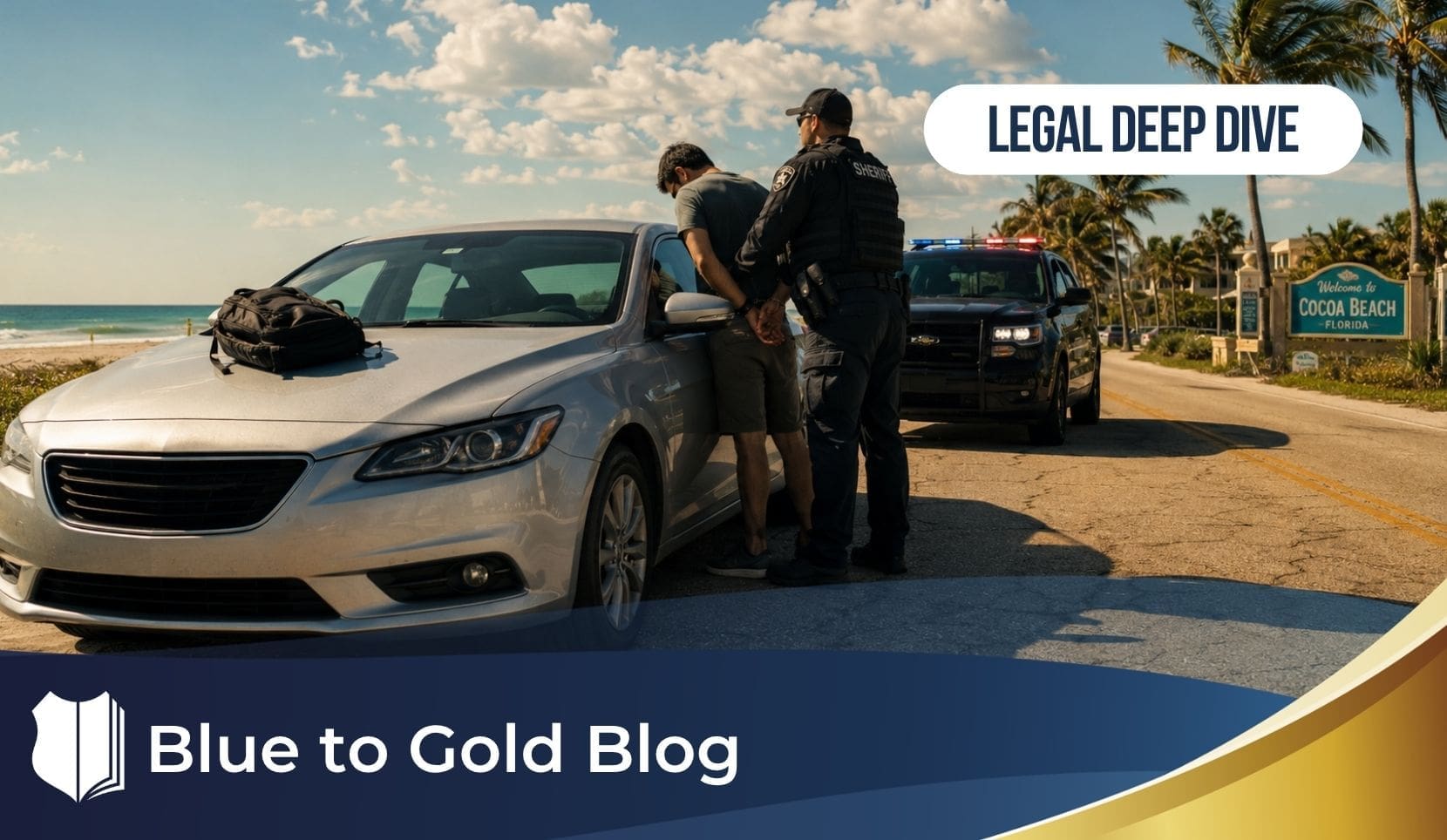

A “search of an item from which a defendant has been physically separated cannot be upheld” under the search-incident-to-arrest (SITA) exception.
Overview
Warrantless “searches conducted outside the judicial process, without prior approval by judge or magistrate, are per se unreasonable under the Fourth Amendment—subject only to a few specifically established and well-delineated exceptions.” “Searches conducted incident to the [lawful custodial] arrest of a person are one such exception.” This search-incident-to-arrest (SITA) exception allows warrantless search only of “the arrestee’s person and the area within his immediate control, i.e., the area into which he may reach to acquire a weapon or destroy evidence.” The scope of this exception is limited; once the arrestee “has been physically separated” from an item, search of it cannot be upheld under SITA. Thus, “in the case of a backpack carried by an arrestee at the time of arrest, once police officers have reduced the backpack to their exclusive control and there is no longer any danger of the arrestee gaining access to [it], the search of the backpack can no longer be justified” as a SITA. Lastly, to instead justify searching an arrestee’s backpack under the inventory (booking) exception, courts have required evidence that the search was done in accordance with the police agency’s standard procedures.
Introduction
Chimel v. California held that in making a lawful custodial arrest, police “may search the arrestee’s person and the area within his immediate control,” meaning only “the area from within which he might gain possession of a weapon or destructible evidence.” Courts have interpreted Gant v. Arizona to limit this scope of SITAs, whereas “[i]f there is no possibility that an arrestee could reach into the area that law enforcement officers seek to search,” this exception does not justify warrantless search. SITAs are justified: “(1) to protect the officer’s safety, and (2) to prevent destruction of evidence.” Thus, “where an arrestee has been secured by police officers and separated from the thing that the officers wish to search, neither of the[se] rationales . . . apply and, accordingly, a search of that thing cannot be conducted as a search incident to arrest.” Although the automobile exception may separately justify searches unique to the motor vehicle context, this Article summarizes court decisions turning on the validity of searching items possessed by an arrestee’s incident to his arrest.
Under Florida Statute 901.21, police making a lawful arrest:
(1) “may search the person arrested and the area within [his] immediate presence [interpreted as under the arrestee’s control];” and
(2) “may seize all instruments, articles, or things discovered on the person arrested or within [his] immediate control.”
Rivera v. State (Second District Court of Appeal 2024): Search of a Secured Arrestee’s Lockbox and Zippered Bags Found in His Pockets Was Impermissible
The defendant “was under arrest and had been handcuffed when his person was searched” in a public location. In his pockets, a locked lockbox and a bag zippered were found and “given to officers on scene to search; they were no longer in Rivera’s control or reach.” The Court explained that “the lockbox and the bag would have been legally seized by the police. But seizure is not the same as search.” “If there is no possibility that an arrestee could reach into the area that [police] seek to search, both justifications [officer protection and evidence preservation] for the search-incident-to-arrest exception are absent and the rule does not apply.” The Court emphasized that the search was not justified by officer safety needs, as there was no evidence that the defendant “was in possession of explosives.”
Ancrum v. State (Second DCA 2014): Search of a Jacket on the Floor of the Bedroom, Where the Defendant was Arrested, After he was Removed from the Bedroom was Impermissible
Police were legally present in the home of the defendant’s relative, arresting Mr. Ancrum on unrelated charges. “Mr. Ancrum’s jacket was located on the floor in the bedroom where Mr. Ancrum was arrested.” During the arrest, Mr. Ancrum was pulled “from his bed to the floor,” then removed from the bedroom. “Where the officers removed Mr. Ancrum from the bedroom before the search,” he was “physically separated from the jacket when it was searched.” Thus, search of the jacket was an invalid SITA, whereas “the search of an item from which a defendant has been physically separated cannot be upheld as a search incident to [his] arrest.”
Harris v. State (Third DCA 2018): Search of a Dismounted Dirt Bike Driver’s Backpack was Invalid Where he was Already Handcuffed and Feet Away from the Backpack
Police initiated a traffic stop of a dirt bike for reckless driving. Although the defendant attempted to drive away, he fell off the dirt bike and was subsequently handcuffed. Police removed a backpack from the arrestee’s person and placed it on the police car hood, instructing him to sit on the grass about 5 feet away. While the arrestee told the officer to look for the dirt bike’s ownership paperwork in the backpack’s front pocket, he specifically stated not to open its main compartment. Police searched the entirety of the backpack, finding narcotics and paraphernalia.
The “officers had reduced Harris’s backpack to their exclusive control and [thus] Harris had no possibility of accessing the backpack. Having so secured the backpack, the police officers were not entitled to search” it as a SITA. The Court discussed: Even “[a]ssuming a dirt bike qualifies as a vehicle” for the automobile exception, the “backpack was not a part of the dirt bike nor stored on or in it. Instead, the backpack was worn by” the arrestee. Moreover, since the defendant was arrested for reckless driving, evidence of this crime would not have been found in his backpack. Thus, neither the automobile nor SITA exceptions applied.
Jean v. State (Sixth DCA 2023): After an Arrestee Dismounted a Bicycle in his Driveway, Search of his Fanny Pack was Invalid Where It was Outside His Reach and he was Already Secured
Police waited nearby the defendant’s home with an arrest warrant. The defendant arrived home on a bicycle and dismounted, wearing 2 bags, a backpack, and a locked fanny pack strapped to his chest. Police walked up to him as he stood in his driveway in front of his garage, behind another vehicle. Although police ordered him to stop and show his hands, the defendant began walking away into his garage, and officers followed, eventually handcuffing him behind his back. Officers removed his bags, and placed the fanny pack on the hood of the car that was in his driveway. At that time, the defendant was 8 to 10 feet away from the fanny pack, with multiple officers surrounding him. An officer “manipulated, squeezed, and felt the locked fanny pack with his hands,” feeling what he perceived to be a firearm. Police searched Mr. Jean for the key, which was found and used to open the fanny pack, which indeed contained an illegally possessed firearm.
“The search of Jean’s fanny pack occurred after [he] had already been totally secured and separated from [it] such that there was no longer any possibility that he could access it in order to obtain a weapon to harm the officers.” Thus, the “search was not permissible.” The Court discussed: Even “[a]ssuming Jean’s bicycle qualified as a vehicle [for the automobile exception], Jean’s fanny pack was not at any point stored on or in the bicycle. Instead, the fanny pack was worn by Jean on his person after he dismounted;” thus the automobile exception did not apply. Finally, no “legitimate officer safety concerns” justified the fanny pack search, as the arrestee was already secured.
Wall v. State (Fifth DCA 2022): Search of the Defendant (Per an Arrest Warrant)’s Purse was Invalid Where It was Inside a Vehicle Outside her Reach at the Time of Arrest
The defendant was an occupant in a parked car approached by law enforcement to investigate possible fraud, following a call from a grocery store manager who suspected the other occupants had used a cloned credit card to purchase gift cards. After all occupants were detained and sitting on the curb, the defendant was discovered to have an active arrest warrant out of Texas. Police searched the defendant’s purse that was inside the car, finding “multiple credit cards not belonging to any of the vehicle occupants.” The Court explained: “The purse was not within Wall’s reach at the time of her arrest because she was out of the car sitting on the curb while the purse was on the passenger seat of the vehicle. In fact, all passengers were out of the vehicle.” Moreover, there was no “indication that there was probable cause that the purse contained evidence related to the Texas warrant for which [she] was arrested.” Thus, “under Gant, the search of the purse was improper.”
State v. Bultman (Second DCA 2015): Search of an Arrestee’s Purse was Permissible Based on Genuine Safety Concerns, in Light of her Refusal to Separate Herself from the Purse
Described as “the only post-Gant, non-automobile Florida case that differs in result, [Bultman] is easily distinguishable” from the other SITA cases discussed herein. The defendant consented to police entering her home “to search for a suspect in an unrelated case.” Police saw an aluminum foil “boat” caked with methamphetamine in her backyard. “The officers then asked . . . for her identification, which she indicated was in her purse located in her car.” She “retrieved her purse and handed the officers her identification. However, Bultman then attempted to hide her purse from the officers, and when they asked to search the purse, she refused. The officers repeatedly asked Bultman to place the purse on the hood of their police car for officer safety and twice had to remove it from her person. The officers arrested [her] for resisting their commands to leave the purse on the hood of the car and conducted a search of her purse incident to arrest.” The search was upheld as a valid SITA.
Harris v. State subsequently reflected on Bultman, distinguishing that “it was the officers’ concern about a weapon and Bultman’s refusal to separate herself from the purse that led to the arrest in the first place. In contrast to an arrest on an unrelated event and a search of the purse, Bultman’s arrest was directly caused by her actions towards her purse.”
Florida Courts’ Comments on Whether These Searches Would Instead Be Justified Under the Inventory (Booking) Exception
While search of an arrestee’s bags may appear—at first blush—to fall under an inventory (booking) search, courts have required evidence that an inventory search was performed in accordance with the agency’s established policy. Courts have also considered evidence—or lack thereof—that the arrestee “would have chosen to take her purse to the jail upon her arrest rather than leave it” elsewhere.
Conclusion
The search-incident-to-arrest (SITA) “exception derives from interests in officer safety and evidence preservation that are typically implicated in [lawful custodial] arrest situations.” A SITA “only includes the arrestee’s person and the area within his immediate control, i.e., the area into which he may reach to acquire a weapon or destroy evidence.” However, “once an arrestee is physically separated from an item or thing, and thereby separated from any possible weapon or destructible evidence,” these concerns no longer justify warrantless search under this exception. Courts have described that “the exceptions to the warrant requirement remain ‘jealously and carefully drawn,’ and there must be ‘a showing . . . that the exigencies of the situation made that course imperative.’” Conversely, courts have applauded seizures of items in an arrestee’s possession, based on probable cause that it “holds contraband or evidence of a crime,” in order to obtain a warrant—circumventing the need to “rebut the presumption that a warrantless search is unreasonable.”
References
- Rivera v. State, 396 So.3d 861, 870-71 (Fla. 2nd DCA 2024) (quoting Ancrum v. State, 146 So.3d 1217, 1220 (Fla. 2d DCA 2014)).
- Harris v. State, 238 So.3d 396, 399 (Fla. 3d DCA 2018) (quoting Arizona v. Gant, 556 U.S. 332, 338 (2009); Katz v. United States, 389 U.S. 347, 357 (1967)).
- Incident to a lawful custodial arrest, police “may search the arrestee’s person and the area within his immediate control,” meaning “the area from within which he might gain possession of a weapon or destructible evidence.” Id. (quoting Chimel v. California, 395 U.S. 752, 763 (1969)).
- Jean v. State, 369 So.3d 1235, 1239 (Fla. 6th DCA 2023) (quoting Smallwood v. State, 113 So.3d 724, 734 (Fla. 2013)).
- “The search of an item from which a defendant has been physically separated cannot be upheld” as a SITA. Harris, 238 So.3d at 402 (citing Ancrum, 146 So.3d 1217).
- Jean, 369 So.3d at 1239 (citing Harris, 238 So.3d at 402).
- Rivera, 396 So.3d at 873 (“[T]he State failed to present any evidence regarding inventory procedures” to prove that search of bags found in the arrestee’s pockets were justified under this exception).
- Chimel v. California, 395 U.S. 752, 763 (1969); see also Harris, 238 So.3d at 400.
- In Gant, “the Supreme Court specifically limited the scope of warrantless [SITA] . . . once an arrestee is physically separated from an item, . . . and thereby separated from any possible weapon or destructible evidence, . . . the dual rationales for this search exception no longer apply.” Smallwood, 113 So.3d at 734-35; see also Gant, 556 U.S. 332.
- Ancrum v. State, 146 So.3d 1217, 1220 (Fla. 2d DCA 2014) (Search of an arrestee’s jacket was an invalid SITA where he “was physically separated from the jacket when it was searched.”).
- Rivera, 396 So.3d at 871; Jean, 369 So.3d at 1239 (citing Smallwood, 113 So.3d at 735; Gant, 556 U.S. at 335).
- “[E]ven when Chimel would not authorize a search incident to arrest of a vehicle, a search of the vehicle incident to the arrest will be upheld when” there is probable cause “to believe evidence relevant to the crime of arrest might be found in the vehicle.” Harris, 238 So.3d at 403 (quoting Gant, 556 U.S. at 343).
- A SITA “only includes the arrestee’s person and the area within his immediate control, i.e., the area into which he may reach to acquire a weapon or destroy evidence.” Smallwood, 113 So.3d at 734; Jean, 369 So.3d at 1239.
- Fla. Stat. § 901.21.
- Rivera v. State, 396 So.3d 861 (Fla. 2nd DCA 2024) (Search of a closed bag and locked lockbox found in the arrestee’s pockets was not justified as a SITA where he was already handcuffed and separated from the containers).
- “‘Different interests are implicated by a seizure than by a search’ because of the less intrusive nature of a seizure.” Id. (quoting Hanifan v. State, 177 So.3d 277, 282 (Fla. 2d DCA 2015)) (“The courts have often approved warrantless seizures of property based on probable cause, for the time needed to obtain a warrant, in cases in which a warrantless search might have been impermissible but when the seizure was used ‘to protect the evidence from destruction.’”).
- Rivera, 396 So.3d, at 873 n.10 (Regarding “concern about safety, it was not objectively reasonable to believe a search of the items removed from [the arrestee’s] person was necessary on the facts of this case.”).
- Ancrum v. State, 146 So.3d 1217 (Fla. 2d DCA 2014) (Search of an arrestee’s jacket found on his bedroom floor, where he was arrested, was invalid where he was “physically separated from the jacket when it was searched.”).
- Harris v. State, 238 So.3d 396 (Fla. 3rd DCA 2018) (Search of a dismounted dirt bike driver’s backpack was an invalid SITA where it was “not in the area within his immediate control at the time of the search.”).
- Jean v. State, 369 So.3d 1235 (Fla. 6th DCA 2023) (“The search of Jean’s fanny pack occurred after [he] had already been totally secured and separated from the fanny pack such that there was no longer any possibility that he could access it . . . such a search was not permissible.”).
- Wall v. State, 333 So.3d 348 (Fla. 5th DCA 2022) (Search of the defendant’s purse, who was arrested pursuant to an arrest warrant, was an invalid SITA where her “purse remained in the vehicle, out of [her] reach and out of the reach of the co-defendants [other occupants who were detained on the curb].”).
- State v. Bultman, 164 So.3d 144 (Fla. 2d DCA 2015) (“Because Bultman had the purse on her person at the time of her arrest for resisting an officer, . . . the officers could lawfully conduct a search of the purse incident to arrest.”).
- Harris, 238 So.3d at 402 (describing Bultman as “the only post-Gant, non-automobile Florida case that differs in result [and] is easily distinguishable” where “it was the officers’ concern about a weapon and Bultman’s refusal to separate herself from the purse that led to the arrest in the first place.”).
- Evidence of the methamphetamine boat was suppressed, “finding the search of the yard to be without consent.” As the Court the defendant was lawfully detained, the drugs in her purse were admissible. Bultman, 164 So.3d at 146.
- “An inventory search serves the needs of protection of the owner’s property, protection of police against claims lost or stolen property, and protection of police against potential danger from such things as explosives.” Wall, 333 So.3d at 351 (quoting Rodriguez v. State, 702 So. 2d 259, 262 (Fla. 3d DCA 1997)).
- Rivera, at 873 n.9 (“[T]he State failed to present any evidence regarding inventory procedures” to justify search of an arrestee’s bags found inside his pockets.) (citing Ross v. State, 319 So. 3d 807, 812 (Fla. 2d DCA 2021); Wall, 333 So.3d at 352) (“Without evidence of such policies to determine whether law enforcement complied with [established governing standard] procedures, the trial court could not properly determine that the inventory search was valid.”).
- Wall, 333 So.3d at 352 (declining to admit evidence found in an arrestee’s purse under the inevitable discovery rule—based on a purported inevitable inventory search—as it was “merely speculat[ion] that the purse would have gone with [her] to jail and that the officers at the jail would search her belongings.”).
- Jean v. Florida, 369 So.3d 1235, 1239 (Fla. 6th DCA 2023) (quoting Arizona v. Gant, 556 U.S. 332, 338 (2009)).
- “This limitation ‘ensures that the scope of a search incident to arrest is commensurate with its purposes of protecting arresting officers and safeguarding any evidence of the offense of arrest that an arrestee might conceal or destroy.’” Id. (quoting Smallwood, 113 So. 3d at 734; Gant, 556 U.S. at 339).
- Harris v. State, 238 So. 3d 396, 402 (Fla. 3d DCA 2018).
- Smallwood, 113 So.3d at 729, 740 (quoting Coolidge v. New Hampshire, 403 U.S. 443, 454-55 (1971)).
- Hanifan, 177 So.3d at 281-282 (concurring op.) (“[T]he officers’ decision to obtain a search warrant . . . was eminently proper, and the ensuing search [of the seized item] was unquestionably legal.”).
- Id. (“commend[ing] the officers . . . who acted with considerable restraint . . . for not actually searching [the arrestee’s] iPhone immediately upon its seizure.”). Although Hanifan pertained to a cell phone, so did the FL Supreme Court case, Smallwood. Yet, Smallwood’s holding—that “once an arrestee is physically separated from an item . . . found on [his] person at the time of arrest, the arrest provides no justification” to search it—informed the decisions discussed herein.